Polymeric facades:
Advanced composites for retrofit

Polymeric facades:
Advanced composites for retrofit
Synopsis
Replacing a building’s façade offers the prospect of improving the whole life performance of the building, in some instances as a favourable alternative to replacing the entire structure. This presents the opportunity to exploit the properties of advanced composite materials for maximum benefit. ‘Upwards and outwards’ retrofit, where extending floor slabs yields extra floor area, is permitted by a lightweight replacement façade, without the need to underpin foundations. For typical medium or high-rise office buildings, the extra let-able space obtained, and reduced heating and maintenance costs, can work to offset the expense of implementation.
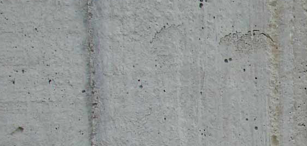
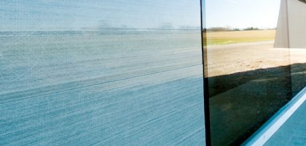
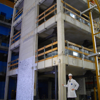
In: Lightweight pultruded GFRP panel for medium/high rise building facade retrofit. (Img. courtesy of Fiberline Ltd.)
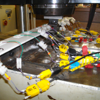
Out: Heavy RC or GRC cladding panels
The specific materials, manufacturing processes, and façade type, most appropriate for such a scheme have been investigated. A unitised façade of sandwich panels with foam cores and pultruded GFRP skins has formed the ‘design platform’ for research conducted.
It is paramount to resolve how the connections in such a façade system can meet the many requirements of an integrated building envelope. Structural integrity, enhanced environmental control, sustainability attributes, fire provisions, acoustic control, ease of manufacture, tolerance control, durability, lightness in weight, cost effectiveness and aesthetics must all be addressed simultaneously by any proposed design methodology.
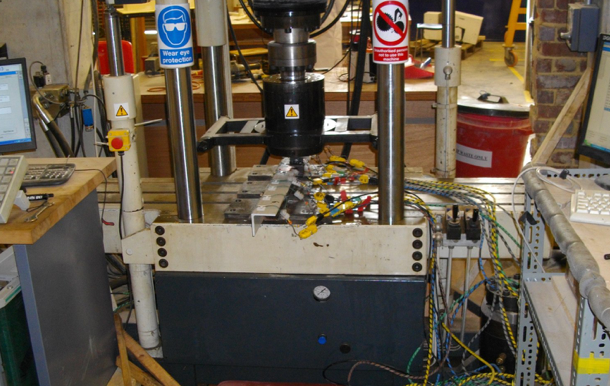
Investigating suitable connections through prototype development and review reveals key issues requiring targeted research. The permanent action acting on light, self-supporting GFRP panels is small, however wind and occupancy loading impart significant imposed actions. Therefore, whilst creep deflection is often a significant consideration for structural GFRP design, quantifying fatigue performance is a higher priority for validating the ideology of polymeric facades.
The unidirectional nature of pultrusion reinforcement yields a scenario of principle stresses at the panel interfaces, occurring in the weaker, secondary fibre, direction. As a consequence a fatigue-testing programme is aimed at understanding the performance and characteristics of pultruded angles compatible with ‘long-edge’ panel connections.
The long-term performance of fibre-reinforced polymer (FRP) structures must be assessed if FRP is to win acceptance as a mainstream material for use in the construction industry. The environmental durability of wholly polymeric structures is often called in to question. In response, accelerated testing is usually undertaken on artificially aged FRP specimens; lack of genuine naturally aged material has previously hindered research and validation of material related design life. Case study investigation has permitted a full durability appraisal of naturally aged GFRP through laboratory testing campaign.
Retrofit of existing buildings as an activity makes up 50% of all building construction in the UK. This project aims to address the shortfall in industry-required design knowledge.
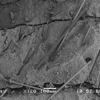
The tensile strength of pultruded naturally aged GFRP has been shown to reduce by only 0.65% over 17 years where natural exposure does not include UV irradiation, and by 13.1% where UV irradiation does occur as one element of exposure. The findings expose the degree of inaccuracy and fundamental flaws in existing predictive ageing models. The physical mechanisms of degradation do not match. A procedure to quantify the extent of polymer brittle hardening has been developed and applied as an analytical tool.
Mechanical testing campaign has pioneered the use of the RMS (Route Mean Square) procedure to present the performance of connection specimens as a continuous function throughout programmes of fatigue testing. Testing has shown that though a threshold strain for damage accumulation does exist in complex fatigue loading of connections, and for direct tension fatigue loading.
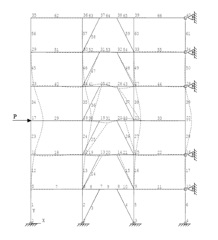
Seismic design and analysis of eccentrically braced steel frames according to EC8
Synopsis
Steel has long been a favourable material for use in seismic resistant design; in this project the properties of the material and of steel frame structures have been reviewed. Benefits and drawbacks have been identified for different types of frame configuration, in plan and elevation, and in connections at joints.
Some pertinent clauses in EC8 pertaining to the categorization of buildings in order to determine a suitable method of analysis have been explored, in some cases by use of an example structure. The reasoning behind inclusion of specific parts of the code has been considered.
Different methods of calculating the distribution and magnitude of a design seismic action have been investigated; the guidance associated with application of these methods, as offered in EC8, has been critically reviewed along with the methods themselves. Quantitative analysis of case studies has provided a means to compare the characteristics of different types of steel frame (seismic loading is a function of the frame as well as external parameters) and the level of agreement exhibited by the different methods for each structure type.
Based on the findings of this project, recommendations have been made with the aim to improve the accuracy of the simpler methods of analysis applied in this report.
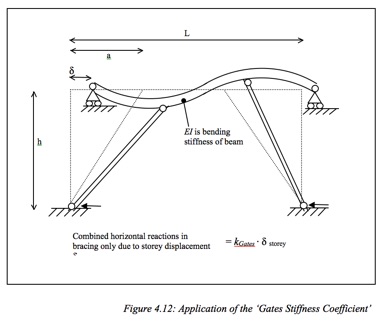
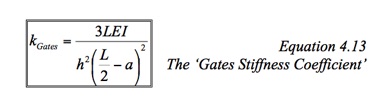
A useful outcome of this project has been the development of a model which determines the contribution to storey stiffness of an eccentrically braced frame. Alternative means to deduce this parameter have been identified and tested, but the model developed in this project has proved to be the most appropriate and validated by case study.
Recommendation for the most beneficial further research into the stiffness model has been made.
Acknowledgments
I would like to thank Dr. Zoubir Benterkia, the supervisor of this research.


Acknowledgments
A huge debt of thanks is owed to the sponsors of this research; Industry partner, Arup, and the Engineering and Physical Sciences Research Council EPSRC.
Project Sponsors:
I would like to thank my supervisors:
Prof. Tim Ibell, Dr. Antony Darby, Dr. Steve Lo and Dr. Mikkel Kragh
Further information
Please refer to the research blog ‘Composite Action’ for further details; blog entires will hopefully eventually catch up with current research actions.
Publications
The two publications can be accessed by clicking on the respective images. Full details of these and other journal and conference papers can be accessed here